
Written by Oghenovo Ese
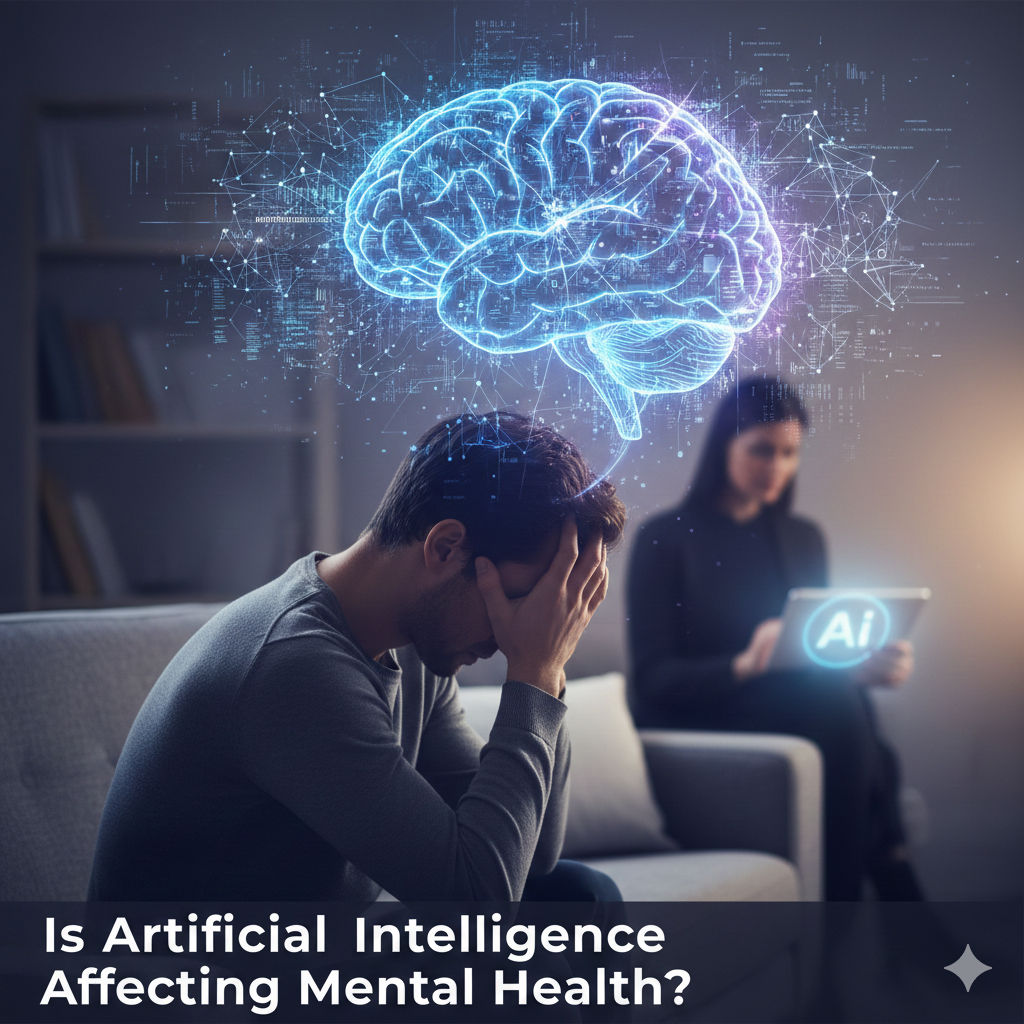
AI has become a major part of human life, and mental health is no exception. Its impact on
mental health is like a double-edged sword, presenting both benefits and risks. It can
provide easy support through chatbots and help detect problems early, but it can also
cause stress from job worries, loneliness, information overload, and less personal care,
which may make issues like depression, anxiety, and low self-esteem worse. Artificial
Intelligence is used positively in music therapy apps and personalized treatments, but it
also raises concerns about data privacy, bias, and over-reliance on machines instead of
real human connection.
Positive Impacts
Better Access & Reduced Stigma: AI tools are available round-the-clock, making it
easier for people who feel uncomfortable with traditional therapy to get help. This also
helps reduce stigma around seeking mental health support.
Early Detection & Personalization: AI can analyze speech, video, and wearable data
(like heart rate and sleep) to detect conditions such as autism, schizophrenia, or mood
disorders early. This allows treatments to be tailored to each person.
Support Tools: AI powers apps for managing emotions, like music-based therapy,
offers virtual therapy platforms, and helps therapists work with complex patient data.
Negative Impacts & Risks
Technostress & Job Anxiety: Rapid AI adoption can cause stress, emotional
exhaustion, and fear of losing jobs, contributing to burnout.
Social Isolation & Less Empathy: Over-reliance on AI companions may reduce time
spent with real people, weakening relationships and empathy, and increasing
loneliness, even if people feel constantly “connected.”
Cognitive & Emotional Overload: Constant AI interaction and curated online content
can increase comparison, feelings of inadequacy, and mental overwhelm.
Ethical Concerns: AI lacks true empathy, may give harmful responses (especially in
critical situations), and can raise issues with data privacy and algorithmic bias, creating
safety risks.
Researchable Areas on this Subject in 2026
Adolescent Well-being: The misuse of AI, such as deep-fakes, online harassment, and
cyberbullying, poses serious threats to young people’s mental health. These harms can
damage self-esteem, increase anxiety and depression, and expose adolescents to
emotional trauma. Strong protective measures are therefore needed, including digital
safety education, parental guidance, school-based awareness programs, ethical AI
regulations, and effective reporting and support systems to safeguard youth well-being.
Long-Term Effects: AI chatbots can help at first by giving quick support and information,
but these benefits may not last over time. Long-term use may make some people depend
too much on AI and talk less to real people. It could also affect how young people manage
emotions, build relationships, and solve problems. Because of this, more long-term
research is needed to understand the lasting effects of AI on mental health and well-being.
References
American Psychological Association. (2023). Artificial Intelligence and Mental Health:
Opportunities and Challenges. American Psychological Association.
https://www.apa.org
Blease, C., Bernstein, M. H., Gaab, J., Kaptchuk, T. J., MacDonald, H., & Mandl, K. D. (2019).
Artificial intelligence and the future of psychotherapy: A review of ethical, clinical, and social
implications. Psychotherapy, 56(4), 563–574.
https://doi.org/10.1037/pst0000251
Frontiers in Psychiatry. (2020). Artificial Intelligence in Mental Health and Well-being: A
Systematic Review. Frontiers in Psychiatry, 11, 573.
https://doi.org/10.3389/fpsyt.2020.00573
Innova Therapy Inc. (2022). The psychological impact of AI and digital dependency.
https://www.innovatherapy.com
Mindful Health Solutions. (2021). Ethical risks of AI-driven mental health tools.
ScienceDirect. (2021). Artificial Intelligence in Mental Healthcare: Applications, Benefits, and
Risks. Journal of Affective Disorders, 281, 103–112.
https://www.sciencedirect.com
Stanford Institute for Human-Centered Artificial Intelligence (HAI). (2022). AI and mental
health: Balancing Innovation and Human Care.
https://hai.stanford.edu
Torous, J., Bucci, S., Bell, I. H., Kessing, L. V., Faurholt-Jepsen, M., Whelan, P., Carvalho, A.
F., & Firth, J. (2021). The Growing Field of Digital Psychiatry: Current Evidence and the Future
of apps, Social Media, Chatbots, and Virtual Reality. World Psychiatry, 20(3), 318–335.
https://doi.org/10.1002/wps.20883